
adapt advisory
Turning complex microclimate data into clear insights for planning and design
wHO WE ARE
Adapt Advisory is a unique service which allows clients to access the climate modelling and adaptation expertise of the Australian Urban Design Research Centre.
The Australian Urban Design Research Centre (AUDRC) is an international centre of excellence for urban design research and teaching at the University of Western Australia. Since 2014, AUDRC has worked closely with its state and local government partner organisations to produce a tranche of policy-relevant core research. For the last three years, AUDRC has worked with state and local government partner organisations on the research project ‘Future Climate, Future Home’ to generate an evidence base to inform the climate adaptation of urban precincts and housing to projected increases in temperatures and to foster climate-resilient communities. Adapt Advisory is a unique opportunity for clients to access the climate modelling and adaptation expertise developed through this project.
Why we exist
Our work helps you understand not just what to do, but also why it works and how it will perform under future climate conditions.
Australian cities continue to face ever-greater challenges due to climate change and population growth. Decision‑makers are being asked to respond with clarity and confidence, yet most climate change adaptation strategies still rely on generalised assumptions rather than context‑specific and evidence-based data.
AUDRC consultancy fills this gap. We turn complex microclimate data into clear insights to strengthen planning, design, and policy decisions.

Our offer
Our evidence‑based insights support better design, stronger policy, and more resilient cities and communities
Buildings, roads, parks, and streetscapes all contribute to the microclimate of urban areas and, therefore, to thermal comfort, liveability and public health. Planners and designers currently lack tools to quantify the impact of urban design and changing climate. We use the world-leading ENVI-met software as our preferred tool.
ENVI-met is a holistic 3D microclimate simulation software used to model the complex interactions between surfaces, plants, air, and buildings in urban environments. It uses fundamental principles of fluid dynamics and thermodynamics to predict microclimatic factors such as temperature, wind, and humidity, as well as the resulting human thermal comfort.
We combine our core urban design expertise with microclimatic modelling and analysis to evaluate how urban form, vegetation and materials influence thermal comfort and lived experience. We use IPCC climate projections in our models to identify how this performance will vary in future, which is critical to the development of adaptation strategies.

Why It Matters
We bridge the gap between design intent and real‑world performance, helping you create places that remain resilient and liveable—today and in the future
Our work provides clarity through quantifiable, evidence-based performance data and visuals that strengthen decision-making, support policy, and improve built outcomes.
Our Services
AUDRC consultancy allows clients to access our climate modelling expertise through a standard fee arrangement that includes a set number of case study precincts, design iterations, and ENVI-met simulations. This ensures that clients receive the project inputs they need on time and within budget.
Specific services include:
Evaluation of conditions in current and future climates
Microclimatic modelling of existing or planned urban precincts using ENVI-met software
Microclimatic modelling of precincts in both current and future (e.g., 2050 or 2080) conditions under different climate scenarios (e.g., SSP3-7.0 or SSP2-4.5)
Quantified microclimatic outcomes and prediction of a range of microclimatic variables including shade, surface temperature, wind, humidity and thermal comfort
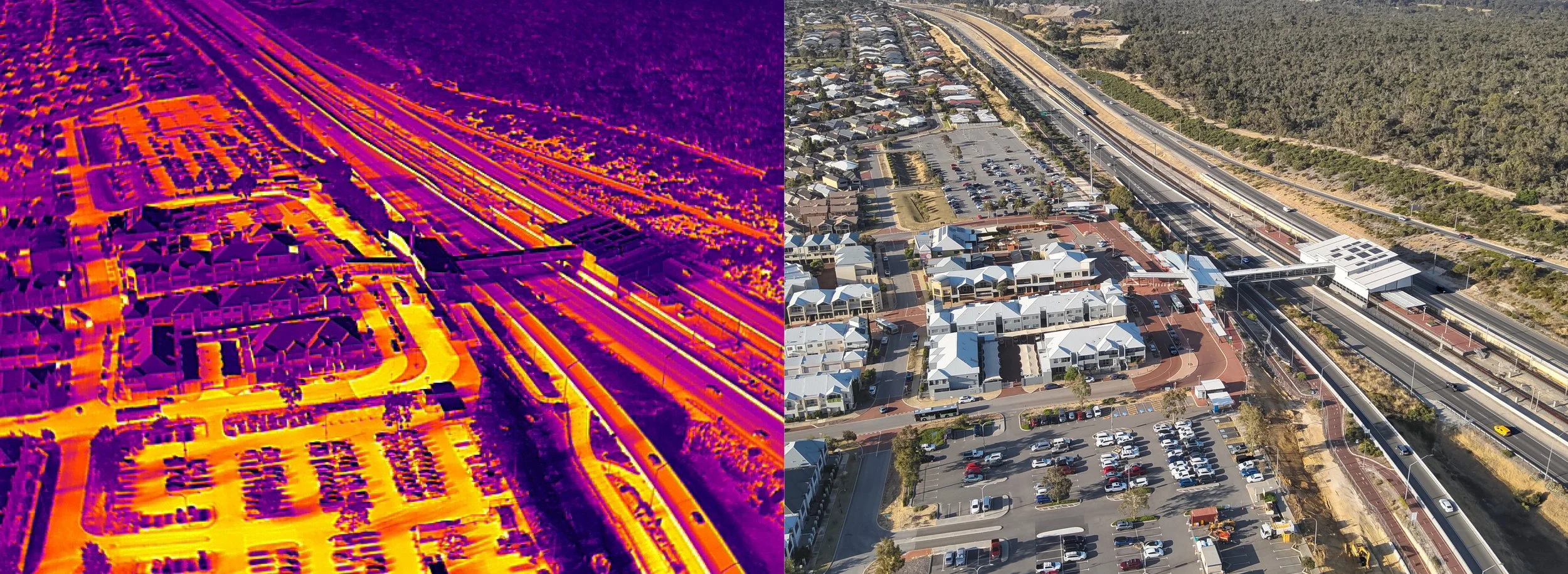
Calibration of microclimatic modelling using field measurement and thermal drone data
Evidence‑based design review of existing or planned precincts
Design proposal testing in current and future climates
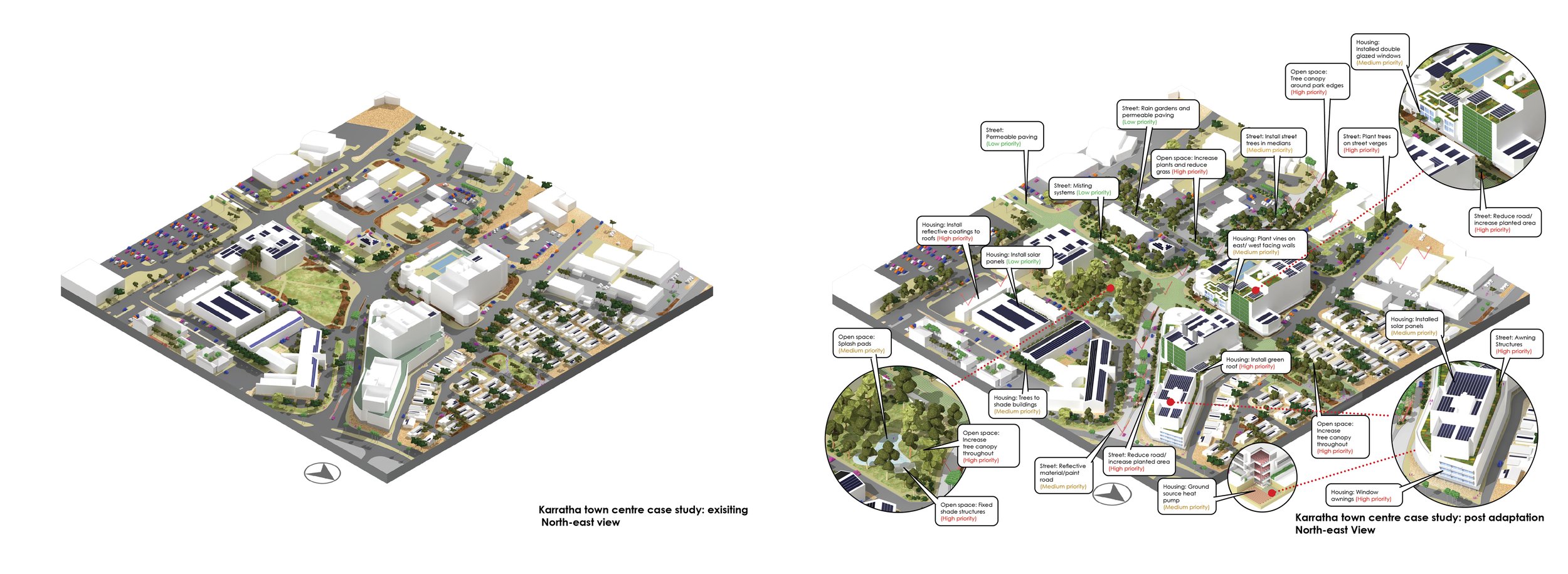
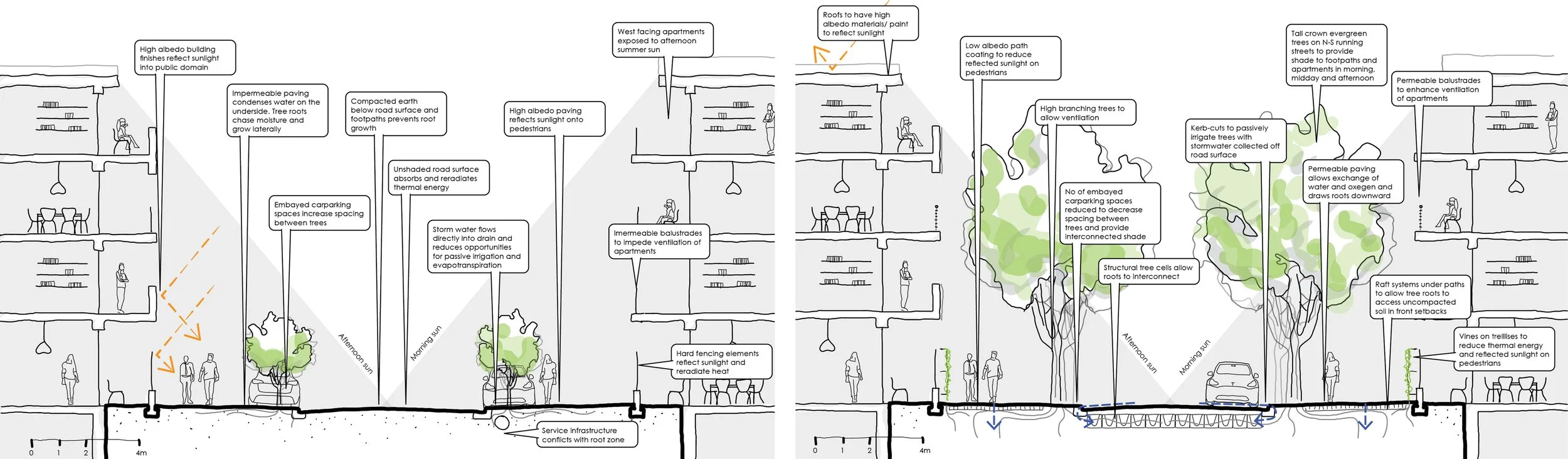
Microclimatic modelling of design proposals incorporating climate adaptation strategies (e.g., tree canopy, shade structures, high-albedo materials or built form massing) using ENVI-met software
Microclimatic modelling of design proposals in both current and future (e.g., 2050 or 2080) conditions under different climate scenarios (SSP3-7.0 or SSP2-4.5)
Quantified microclimatic outcomes and prediction of a range of microclimatic variables including shade, surface temperature, wind, humidity and thermal comfort
Evidence‑based design review of design proposals
Urban forest and green infrastructure analysis
Green infrastructure strategy development and analysis
Tree canopy performance and species selection
Planting configurations and cooling potential
Prioritisation planning to support urban forest and greening strategies and policies
Public health plan development
Strategy development to protect communities from climate-related health risks (e.g., during heatwaves or droughts)
Who We Work With
We support organisations in Australia and the Asia-Pacific region across planning, design, infrastructure, and policy:
State Government & Agencies: Government‑led urban developers, urban planning, housing, transport, environment and health departments
Local Government: Metropolitan and regional local governments
Non-government organisations: Public health organisations, urban design organisations
Private Sector: Land developers, home builders, urban planning firms, urban design firms, architectural firms, landscape architecture firms and mining companies
Research & Education: Universities and research institutes, secondary and primary schools
OUR PEOPLE
Our multidisciplinary team combines leadership in urban design and landscape architecture with specialist expertise in green infrastructure, microclimate modelling, public health, field measurement, thermal drone data capture and GIS analysis.






current clients
Our current clients span government and industry. Government partners include Western Australian state agencies—such as the Western Australian Planning Commission, Department of Planning, Lands and Heritage, DevelopmentWA, Department of Housing and Works, Water Corporation, Main Roads Western Australia and Department of Transport—as well as metropolitan and regional local governments. Our industry clients include leading property development and urban and landscape design organisations, including Mirvac and UDLA.










Contact
To discuss a potential project and receive a fee proposal, please contact partnership manager Caine Holdsworth by emailing caine.holdsworth@uwa.edu.au or ringing 0413282103.